Buy Baudricourt

Baudricourt

  • Baudricourt Thin
  • Baudricourt Extralight
  • Baudricourt Light
  • Baudricourt Regular
  • Baudricourt Medium
  • Baudricourt Semibold
  • Baudricourt Bold
  • Baudricourt Extrabold
  • Baudricourt Black
  • Baudricourt Thin Italic
  • Baudricourt Extralight Italic
  • Baudricourt Light Italic
  • Baudricourt Italic
  • Baudricourt Medium Italic
  • Baudricourt Semibold Italic
  • Baudricourt Bold Italic
  • Baudricourt Extrabold Italic
  • Baudricourt Black Italic

A new map of Paris’s iconic Brutalist buildings charts the city’s uneasy relationship with the style.

TT
❶❾❻❾ ②⓪②⑥
Goudron, Asphalte & (Béton)

The idea of photographically cataloguing Paris in 1970 should come as no great surprise, for it had historical precedents. Since the nineteenth century, the destruction of Paris has gone hand in hand with its preservation in images. Georges-Eugène Haussmann, whose name has become synonymous with Paris’s rational urbanization, should also be remembered for his work to establish a visual archive of the city’s history and a public museum in which to display it: the musée Carnavalet. He saw this as a necessary complement to the major upheaval of urban renovation. The systematic visual documentation of the city before, during, and after its transformations that he commissioned from Charles Marville and the too-often-overlooked watercolorist Fedor Hoffbauer would help the public and historical experts alike remember and study the city’s past and present. Starting in the last decades of the nineteenth century, new groups and institutions including the Commission municipale du Vieux Paris (dedicated to studying and preserving the traces of the sixteenth, seventeenth, and eighteenth centuries), the musée Carnavalet, and the Bibliothèque historique ensured the continuation of this process of preserving the city in images. They commissioned photographic documentation of buildings and streets that were slated for destruction and purchased photos that presented important evidence of the city’s history. From 1903 to 1907 the Commission municipale du Vieux Paris even sponsored a series of amateur photo contests designed to produce urban documentation at low cost. Much as Haussmannization had incited these first efforts to photograph Paris systematically, the city’s transformations in the 1960s and 1970s inspired Claude Gourbeyre, then mayor of the 20th arrondissement, to propose the largest single attempt to catalogue Paris photographically. By participating in the contest’s organization, Paris’s largely conservative municipal council, like Haussmann, admitted that contemporary urbanization meant the destruction of historic neighborhoods. Although the product of cooperation between numerous groups and individuals on both sides of the political spectrum, the contest must have been conceived, at least in part, as an effort to convince Parisians of city officials’ attention to the importance of historic preservation – if only in pictorial form. This article describes the contest that Gourbeyre’s suggestion inspired. It argues that ‘C’était Paris en 1970’ adapted the rich visual tradition of Parisian transformation for an era of mass photography. The contest’s organizers embraced the idea championed throughout the century that everyone could be a photographer; by extension, as its advertisements bragged, photography could ‘transform all Parisians into reporters, into archivists, into explorers of the Parisian sublime or commonplace. Promotional materials promised that ‘even very simple cameras’ (and even in the hands of amateurs) could produce valuable, archival quality images. Presumably the contest also turned thousands into avid consumers of the cameras, film, and developing services available at the Fnac. Nonetheless, during a period in which professional photographs sold by private press agencies cost dear, how better to document a whole city than by taking advantage of camera-clad volunteers? Amateurs as an obvious solution to the problem of creating photographic documentation would become unthinkable in the years to come as photography was absorbed into official institutions and discourses of high art and culture in France. Although multiple similar amateur photo contests intended to document a place or time, from the Fnac’s ‘C’était Toulouse en 1986’ to The New York Times’ 2010 ‘A Moment in Time,’ have taken place since, and amateur photographers and their social networking sites continue to create incidental records of global events, ‘C’était Paris en 1970’ marks the last time that a government body confided the creation of officially sanctioned documentation on this scale to amateurs. The resulting photographs show that the conference’s organizers had every reason to expect that amateur photographers could produce a vibrant record of modern life in a period of rapid urban change.

TT
A Political Plan For “New Paris”
Great Wall of China Three Gorges Dam Lenin’s Mausoleum Frank Lloyd Wright Stadium Arcadium Archimedes’ screw LaGuardia Airport Injection moulding St. Peter’s Square Marina Bay Sands Amtrak Cascades Dome of the Rock Chrysler Building Arrondissements Reindustrializing Superstructures Concrete Blonde Neighbourhoods
TT
La Défense takes its name from the statue La Défense de Paris by Louis-Ernest Barrias, which was erected in 1883 to commemorate the soldiers who defended Paris during the Franco-Prussian War. In September 1958, the Public Establishment for Installation of La Défense (EPAD) buildings (of which the Esso Tower was the first) were constructed and began to slowly replace the city's factories, shanties, and even a few farms. The Centre of New Industries and Technologies (CNIT) was built and first used in 1958. These “first generation” skyscrapers were all very similar in appearance, limited to a height of 100 metres (330 ft). In 1966, the Nobel Tower was the first office skyscraper built in the area. In 1970, the RER line A railway was opened from La Défense to Étoile. In 1974, a contract for a Défense-Cergy high-speed hovercraft train was signed and soon abandoned. In the early 1970s, in response to great demand, a second generation of buildings began to appear, but the economic crisis in 1973 nearly halted all construction in the area. A third generation of towers began to appear in the early 1980s. The biggest shopping centre in Europe (at the time), the Quatre Temps, was created in 1981. In 1982, the EPAD launched the Tête Défense competition to find a monument to complete the Axe historique, which eventually led to the construction of Grande Arche at the west end of the quarter. During the same period, hotels were constructed, the CNIT was restructured, and in 1992, Line 1 of the Paris Métro was extended to La Défense, which made the area readily accessible to more of the city. On Bastille Day 1990, French electronic composer Jean-Michel Jarre staged an ambitious concert at the site, using the Grande Arche and three of the area’s towers as projection screens, and building a pyramidal stage above the road. The free concert, titled Paris la Défense, attracted two million spectators, stretching all the way back to the Arc de Triomphe. This beat Jarre’s own previous world record for the largest attendance for a musical concert. After Jean Michel Jarre, German DJ Sash! and the singer La Trec set the video clip for their song Stay at La Défense in 1997. After a stagnation in new development in the mid-1990s, La Défense is once again expanding and is now the largest purpose-built business district in Europe.
TT
The idea for a multicultural complex, bringing together different forms of art and literature in one place, developed, in part, from the ideas of France’s first Minister of Cultural Affairs, André Malraux, a proponent of the decentralisation of art and culture by impulse of the political power. In the 1960s, city planners decided to move the food markets of Les Halles, historically significant structures long prized by Parisians, with the idea that some of the cultural institutes be built in the former market area. Hoping to renew the idea of Paris as a leading city of culture and art, it was proposed to move the Musée d’Art Moderne to this new location. Paris also needed a large, free public library, as one did not exist at this time. At first the debate concerned Les Halles, but as the controversy settled, in 1968, President Charles de Gaulle announced the Plateau Beaubourg as the new site for the library. In 1969, Georges Pompidou, the new president, adopted the Beaubourg project and decided it to be the location of both the new library and a centre for the contemporary arts. In the process of developing the project, the IRCAM (Institut de Recherche et Coordination Acoustique/Musique) was also housed in the complex. The Rogers and Piano design was chosen among 681 competition entries. World-renowned architects Oscar Niemeyer, Jean Prouvé, and Philip Johnson made up the jury. It was the first time in France that international architects were allowed to participate. The selection was announced in 1971 at a press conference, where the contrast between the sharply-dressed Pompidou and “hairy young crew” of architects represented a ‘grand bargain between radical architecture and establishment politics.”
(Structure) & [Vie Commune] Groupe de Délibération Association de Quartier {Footbal-Club} ¡ Dialogue !

Technical information

Technical informationTechnical informationTechnical information
Technical informationTechnical informationTechnical informationTechnical information
Uppercase Basics 26
Lowercase Basics 26
Figures 10
Uppercase Extended 108
Lowercase Extended 111
Oldstyle Figures 10
Superscript 10
Subscript 10
Fractions 7
Punctuation 38
Symbols 13
Currency symbols 6
Math symbols 22
Ordinals 2
Diacritical Marks 13
Ligatures 15
Case Sensitive Forms 4
Circled Numbers 10
Black Circled Numbers 10
Arrows 18
Name
Unicode
Design
Max Esnée
Engineering
Emma Marichal
Graphic Design
Max Esnée, Jules Rousseau
Formats
Static (OTF, TTF, WOFF, WOFF2), Variable (TTF)
Release
Last updated

About

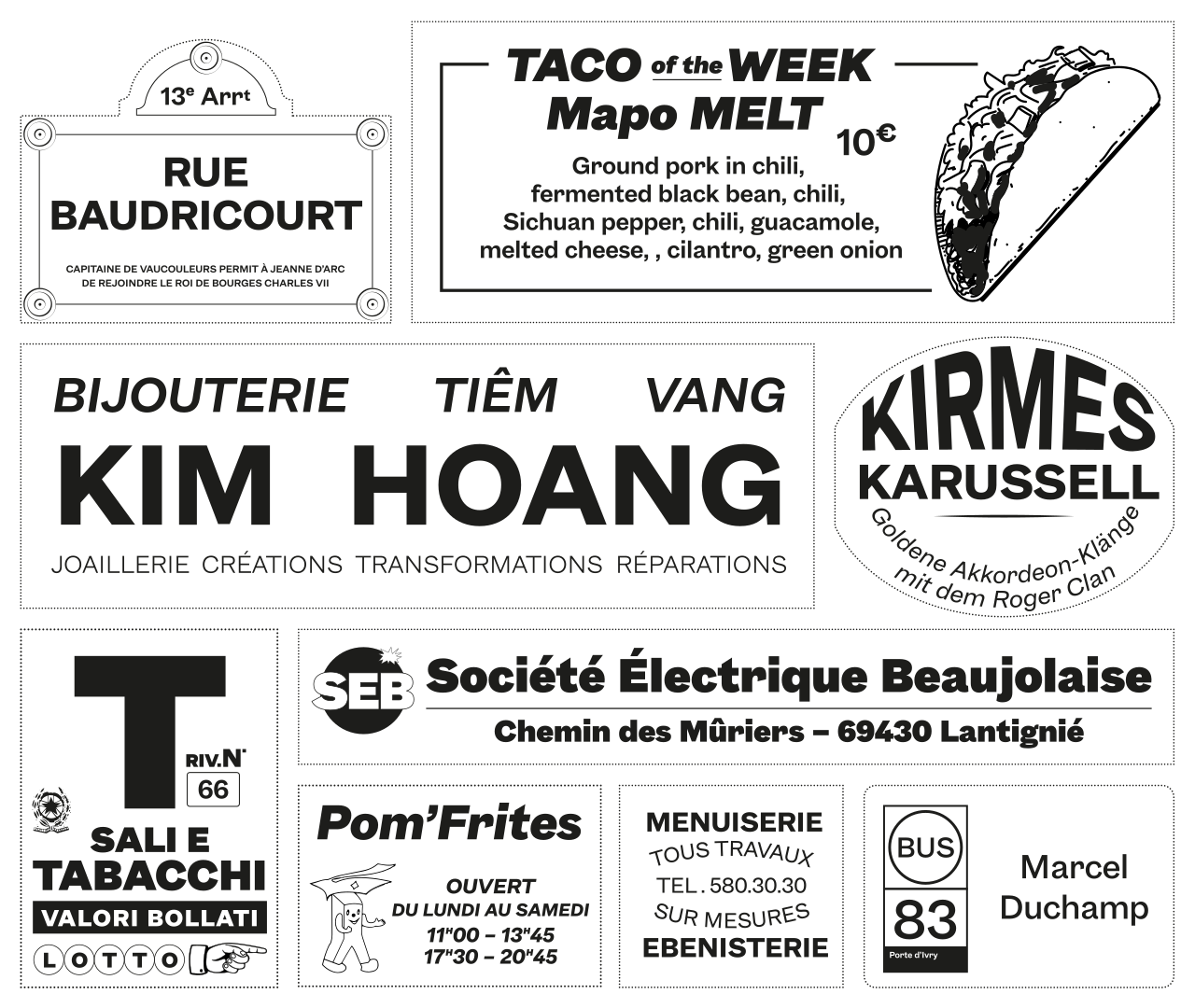
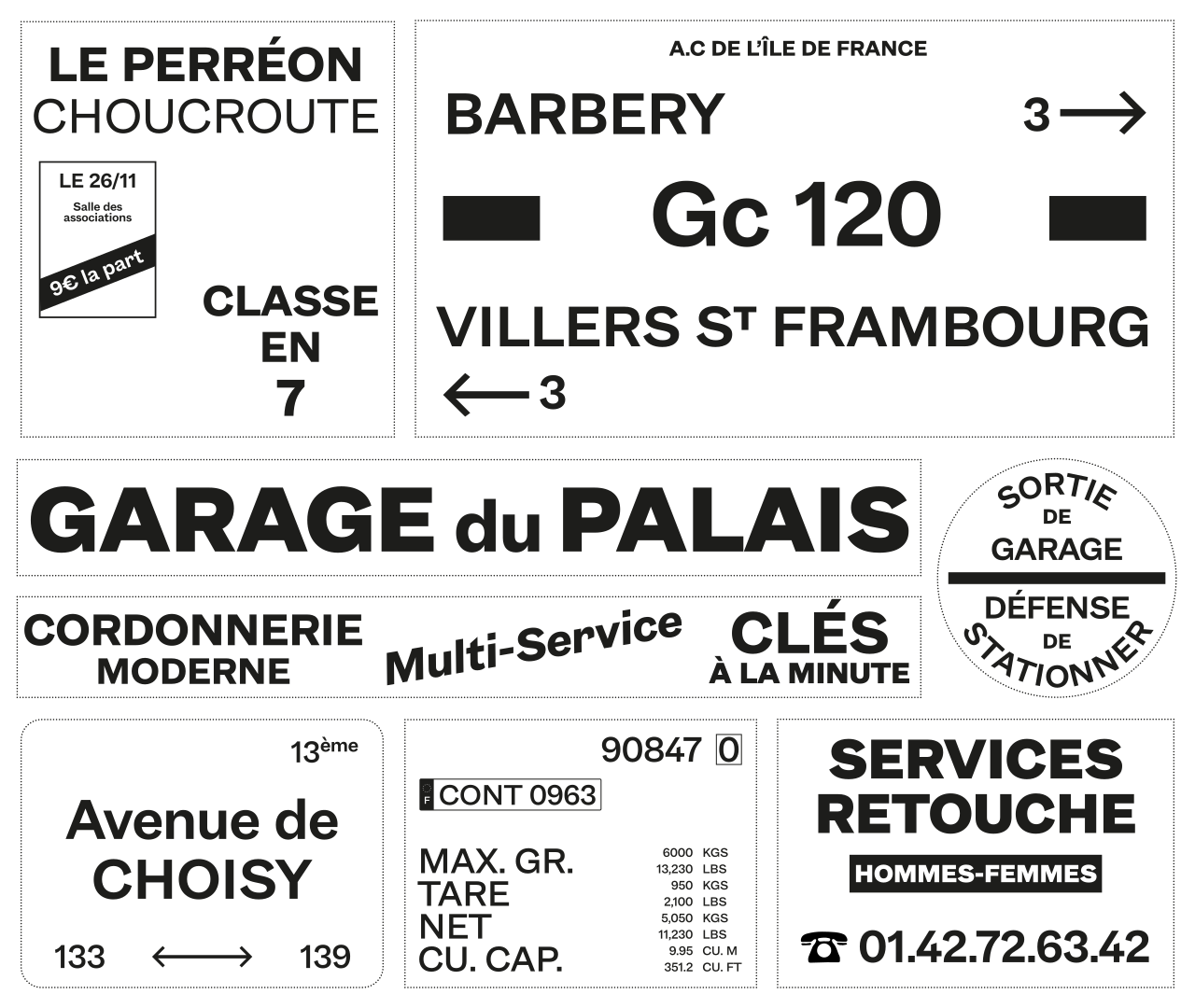
Baudricourt is type family inspired by sans-serif typefaces of the late 19th century, in particular, Grotesque N°1 by Miller & Richard and the Doric Series of H. W. Caslon. It particularly retains a certain expressiveness, due to its fluid forms and strong endings.

Language Support
316 latin languages
Acoli, English, Finnish, French, Galician, Gawwada, German, Hadiyya, Hanga, Harari, Irish, Kalaallisut, Kaonde, Kurdish (Latin), Lamnso’, Luo, Malagasy, Punu, Scottish Gaelic, Tsamai, Wendat, Achinese, Afar, Afrikaans, Alago, Albanian, Alekano, Aleut, Anaang, Ao Naga, Arabic, Chadian Spoken, Aragonese, Aromanian, Asu, Awak, Aymara, Azerbaijani, Balinese, Banda, West Central, Bangwinji, Bapuku, Basque, Batak Toba, Bedawiyet, Bekwarra, Bemba, Bena, Bench, Benga, Biali, Bikol, Bilen, Bislama, Bokobaru, Bosnian, Bube, Buginese, C’Lela, Catalan, Cebuano, Chamorro, Chiduruma, Chiga, Chimborazo Highland Quichua, Chokwe, Chuukese, Colognian, Comorian, Ngazidja, Cornish, Corsican, Crioulo, Upper Guinea, Croatian, Czech, Danish, Dawro, Delaware, Dikaka, Dutch, Ekajuk, Embu, Esperanto, Estonian, Faroese, Fijian, Filipino, Friulian, Fuliiru, Gagauz, Gamo, Ganda, Gheg Albanian, Gilbertese, Gofa, Gourmanchéma, Gusii, Gyele, Haitian Creole, Hiligaynon, Hmong, Hopi, Hungarian, Icelandic, Iloko, Inari Sami, Indonesian, Innu, Interlingua, Iraqw, Italian, Izere, Jamaican Creole English, Javanese, Jibu, Jola-Fonyi, Kabuverdianu, Kaingang, Kalanga, Kalenjin, Kamba, Karelian, Kashubian, Khasi, Kikuyu, Kimbundu, Kinyarwanda, Kituba, Kombe, Kongo, Konjo, Kuanyama, Kunama, Kutep, Kutu, Kwere, K’iche’, Lamba, Lango, Uganda, Latgalian, Latin, Latvian, Lele, Ligurian, Lithuanian, Lombard, Lomwe, Low German, Lower Sorbian, Luba-Lulua, Luguru, Lule Sami, Lunda, Luvale, Luwo, Luxembourgish, Luyia, Machame, Makhuwa, Makhuwa-Meetto, Makonde, Malay (Latin), Maltese, Mambila, Nigeria, Mandinka, Mandjak, Mankanya, Manx, Manyika, Maori, Mapuche, Masaaba, Meru, Minangkabau, Mirandese, Mohawk, Morisyen, Muscogee, Mwani, Nara, Ndamba, Ndau, Ndonga, Neapolitan, Ngindo, Ngulu, Niuean, North Ndebele, Northern Sami, Northern Sotho, Norwegian, Norwegian Bokmål, Norwegian Nynorsk, Novial, Nupe-Nupe-Tako, Nyanja, Nyankole, Nyasa Tonga, Nyemba, Nyoro, Occitan, Ogbah, Okiek, Oromo, Otuho, Palauan, Pampanga, Papiamento, Picard, Piedmontese, Pogolo, Pohnpeian, Pökoot, Polish, Portuguese, Rarotongan, Rendille, Réunion Creole French, Rinconada Bikol, Romanian, Romansh, Rombo, Ronga, Rundi, Rwa, Saho, Samburu, Samoan, Sandawe, Sango, Sangu, Sãotomense, Sapiny, Sardinian, Sassarese Sardinian, Scots, Sena, Serbian (Latin), Seri, Seselwa Creole French, Shambala, Sheko, Shilluk, Shona, Sidamo, Silesian, Slovak, Slovenian, Soga, Somali, South Ndebele, Southern Sami, Southern Sotho, Spanish, Sranan Tongo, Suba, Sukuma, Sundanese, Swahili, Swahili, Congo, Swati, Swedish, Swiss German, Tahitian, Taita, Takwane, Tedim Chin, Tetum, Tiv, Tok Pisin, Tokelau, Tonga, Tooro, Tsonga, Tsuvadi, Tswana, Tula, Tumbuka, Turkish, Turkmen (Latin), Uab Meto, Umbundu, Upper Sorbian, Uyghur (Latin), Venetian, Veps, Vidunda, Volapük, Võro, Vunjo, Walloon, Walser, Waray, Warlpiri, Wayuu, Welsh, West Albay Bikol, Western Frisian, Wolaytta (Latin), Wolof, Xavánte, Xhosa, Yao, Yapese, Yasa, Yucateco, Zaghawa, Zande, Zayse, Zigula, Zulu
Buy Baudricourt

We believe in straightforward and flexible licensing. Our single license type covers all your needs, from personal to commercial projects across print, web, apps, and social media.


For full details, please refer to the complete End-User License Agreement (EULA).